The Best Lemonade Spritz Starts Slightly Too Sharp
A café-style lemonade spritz demands a specific structural tension. Most home attempts begin with a perfectly balanced still lemonade, which immediately collapses into a watery disappointment when poured over ice and topped with sparkling water. The initial base must carry an aggressive edge. To survive the thermal shock of dropping from room temperature near 21°C to 2–4°C in the glass, the concentrate needs roughly one and a half times the sweetness of a standard still lemonade.
Balance emerges through the interaction of acidity, dilution, and carbonation.
When a drink transitions from room temperature to near-freezing, the human palate perceives sweetness less intensely. A base that tastes perfectly pleasant in a mixing bowl will taste hollow once chilled. The decision to formulate the base as intentionally over-concentrated came out of testing standard lemonade ratios, which consistently lost their structural acidity once subjected to the thermal shock of ice and cold carbonation. Building a resilient foundation ensures the drink remains lively from the first sip to the last.
Choose Ingredients That Keep the Spritz Clear and Lively
Building a clear, effervescent drink requires precise component selection. The foundation relies on fresh lemon juice, simple syrup, chilled sparkling water, solid ice, and a fresh aromatic garnish. Granulated sugar resists dissolving in cold liquids, leaving a gritty residue at the bottom of the glass. A 1:1 simple syrup ratio by volume, landing in the range of 50 Brix, incorporates seamlessly into the cold base.
The sparkling water must carry substantial bite.
Water packed with 3.5 to 4 volumes of CO2 provides the necessary lift to carry the heavy citrus oils. Flavored or mineral-heavy waters introduce competing notes that muddy the citrus profile. A neutral, highly carbonated water allows the lemon and sugar to remain the focal point. Cold simple syrup became the standard sweetener after an initial approach of muddling granulated sugar directly with lemon was rejected; the cold sparkling water consistently left gritty, undissolved sugar crystals in the glass.
Mix a Lemonade Concentrate Before Reaching for Bubbles
Morning prep in a busy café establishes the rhythm for the entire day. The citrus station focuses entirely on establishing a reliable baseline before the first order arrives. An average Eureka lemon sits at about pH 2.3 to 2.4, providing a sharp, consistent acidity that cuts through heavy syrups. Our standard starting formula combines 30 milliliters (2 tablespoons) of fresh lemon juice with 20 milliliters (4 teaspoons) of simple syrup.
That 30ml to 20ml ratio came from balancing the average acidity of commercial Eureka lemons against the standardized sweetness of a fully cooled 1:1 simple syrup. It creates a reliable baseline that scales easily for high-volume service.
Straining the lemon juice removes the pulp, resulting in a polished texture that integrates cleanly with the carbonation. A rustic, unstrained version works well for casual service, provided the seeds are removed. Making the simple syrup requires dissolving equal volumes of sugar and warm water, then cooling it completely before use. Warm syrup will prematurely melt the ice and flatten the carbonation.
Build the Spritz Without Knocking Out the Carbonation
The assembly phase dictates the final texture of the drink. Dropping ice into a glass and aggressively pouring sparkling water directly over the cubes creates immediate, messy foam. That rapid degassing destroys the effervescence before the drink reaches the table.
Fill a tall, chilled glass generously with solid ice cubes in the 1- to 2-inch range. Large, solid ice slows dilution significantly compared to smaller chips. Pour the prepared lemon concentrate over the ice.
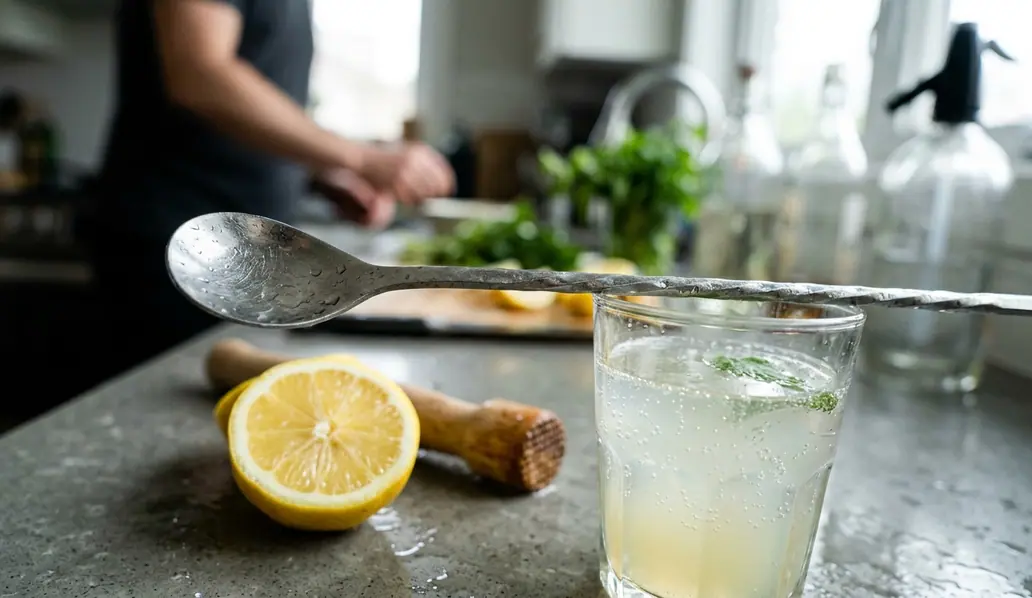
Add 120 milliliters (1/2 cup) of chilled sparkling water slowly at a 45-degree pour angle against the glass interior. Pouring down the inside of a tilted glass minimizes nucleation sites, preserving the dissolved carbon dioxide that would otherwise escape as immediate foam. Finish with a single gentle lift using a long spoon from the bottom of the glass. Vigorous stirring agitates the liquid unnecessarily and forces the remaining bubbles out of suspension.
Correct a Spritz That Tastes Too Sour, Sweet, or Thin
Even with a standardized formula, varying lemon acidity requires occasional correction. The key to adjusting a spritz lies in restraint—make micro-adjustments in 2.5ml to 5ml (1/2 to 1 teaspoon) increments. Adding a large volume of syrup to fix a sour drink will bury the citrus entirely.
Citrus Balance Adjustments
| Sensory Symptom | Likely Cause | Incremental Fix |
|---|---|---|
| Aggressively Sour | Underripe lemon; high acidity | Add 2.5ml to 5ml simple syrup; stir once |
| Flat Sweetness | Overripe lemon; insufficient acid | Add 5ml fresh lemon juice |
| Thin or Watery | Over-dilution from melting ice | See dilution limits below |
Dilution presents a stricter challenge. Hollow machine ice melts within three or four minutes, rapidly over-diluting the base. Rebuilding a badly diluted spritz by adding more syrup and lemon juice directly to the watery glass rarely succeeds. The excess liquid volume prevents the carbonation from recovering, resulting in a flat, heavy beverage. If a drink sits too long and loses its structure, starting fresh yields a better result than attempting to salvage the diluted remains.
Add Tea or Herbs Without Losing the Lemonade
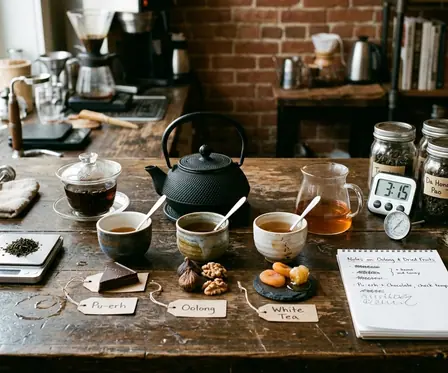
Expanding the flavor profile requires careful integration of secondary ingredients. Tea and herbal infusions offer complex aromatics, provided they do not dilute the core structure. Brew tea at double normal strength, using two standard tea bags per 120ml of water. Steep the infusion for four to five minutes before chilling it quickly to 4°C.
Replace only a portion of the sparkling water with the chilled tea to maintain the effervescent texture.
Tannin structure guides the pairing. Astringent black teas pair best with expressed lemon peel oils rather than direct juice, which keeps the acidity from clashing. Green tea aligns with fresh mint, hibiscus complements basil, and a mild herbal infusion supports thyme. These combinations introduce depth while respecting the foundational balance of the spritz.
Serve the Spritz While the Ice Still Sounds Crisp
Consistency relies on a predictable workflow. Separating the stable acidic components from the volatile carbonation and ice allows for efficient service. The pre-batched lemon-syrup concentrate holds its best flavor for four to six hours in a sealed container at 4°C. When an order arrives, the assembly takes moments.
Add fresh ice, pour the cold sparkling water gently, and execute the single gentle lift—a second or two of movement, no more. Taste and adjust minimally.
A home brewer sets down two tall glasses on a shaded balcony after lunch, adds chilled sparkling water, lifts each drink once with a spoon, and serves them while bubbles still gather around the lemon peel.